



Mikael Orvomaa is the Chief Revenue Officer at QOCO Systems Ltd. Over the years he has been in post, he has led the company’s rapid global expansion alongside the widening of the offering portfolio. Mikael has an extensive background of leadership positions in management consulting, where he focused on large-scale digital transformation initiatives in the industrial sector, with engagements spanning aviation to marine and manufacturing to automotive.
Since the founding of QOCO in 2009, every customer we have ever had has chosen to stay with us.
Here is Mikael Orvomaa’s interview in the Aircraft IT MRO V15 Q3 2026 issue.
Aircraft IT: What was the origin of QOCO Systems and what was its founding vision and mission?
Mikael Orvomaa: QOCO Systems was founded in 2009 by Tech Ops professionals working for a European airline, who felt they could create a larger impact in the industry by setting up their own company with the mission to increase efficiency in aviation technical operations. They aimed to introduce new kinds of digital-native solutions and processes. Since then, the company has been doing just that — understanding the biggest challenges and inefficiency drivers in aviation Tech Ops and coming up with clever, yet robust, and scalable solutions to those problems.
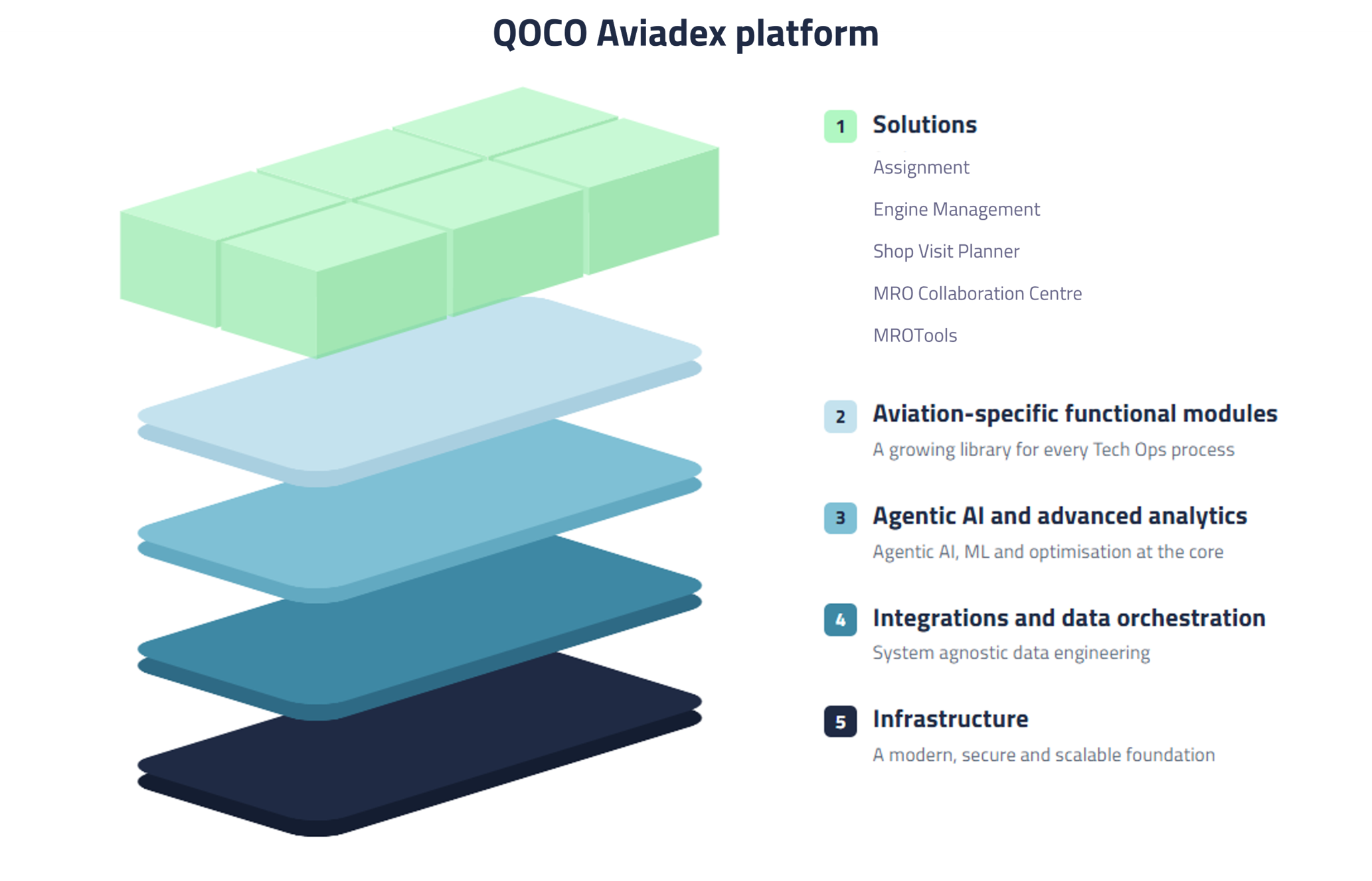
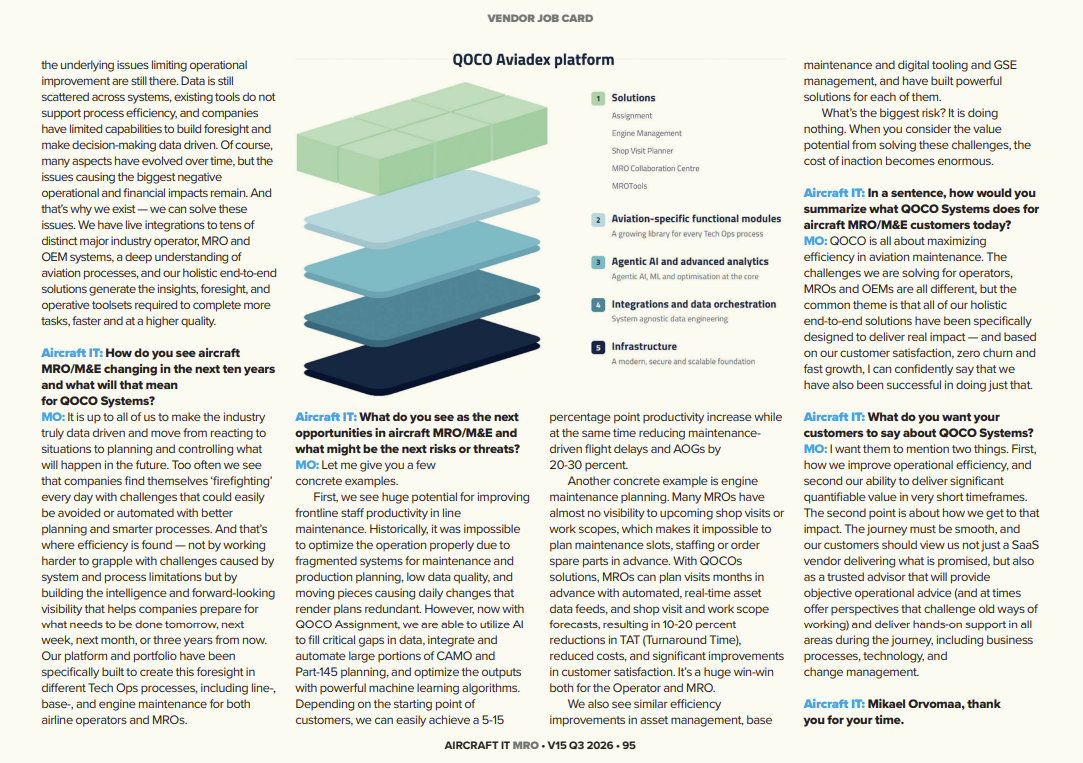
These solutions all come together on our Aviadex platform, where we offer solutions across the Tech Ops domain from asset management solutions to AI-driven production planning, MRO vendor-operator collaboration during maintenance, and production execution. We work with airlines, MROs, and OEMs, and our mission statement and solution design principles cater to all types of stakeholders, from frontline staff to executive management requirements.
Aircraft IT: What is the guiding business principle that drives QOCO Systems today?
MO: Traditionally M&E systems have been focused on managing the regulatory and compliance requirements of the industry for ensuring airworthiness. They were not designed to primarily support efficient operations or digital-native processes (while simultaneously ensuring airworthiness). They are a source of understanding for what has been carried out in the past and what is being carried out as we speak, but they were never designed to forecast or plan the future.
The source of operational efficiency is in the ability to do just that; having access to and the ability to mine data for forward-looking insights and foresight, combined with an understanding of how processes could be redesigned for efficiency without compromising quality and safety. At QOCO, we center everything we do on this notion, and bring this thinking to life in powerful, AI-enabled solutions with accurate information and modern interfaces that are intuitive to use.
Aircraft IT: What makes you proud of QOCO Systems?
MO: The impact we create for our customers. Since the founding of QOCO in 2009, every customer we have ever had has chosen to stay with us and deepen our collaboration further — we can proudly state that we still have a lifetime churn rate of Zero! I think that speaks for itself: our solutions generate concrete value that our customers recognize. On top of having the most powerful solutions for improving Tech Ops, our people take great pride in delivering above expectations, which means that we always do what is promised, at exceptional quality and within the time frame that is expected.
Aircraft IT: How do you think aircraft MRO/M&E has changed since QOCO Systems started and how has the business dealt with changes in the sector?
MO: Honestly, less than it should have. Changes since 2009 have been modest, and the underlying issues limiting operational improvement are still there. Data is still scattered across systems, existing tools do not support process efficiency, and companies have limited capabilities to build foresight and make decision-making data driven. Of course, many aspects have evolved over time, but the issues causing the biggest negative operational and financial impacts remain.
And that’s why we exist — we can solve these issues. We have live integrations to tens of distinct major industry operator, MRO and OEM systems, a deep understanding of aviation processes, and our holistic end-to-end solutions generate the insights, foresight, and operative toolsets required to complete more tasks, faster and at a higher quality.
Aircraft IT: How do you see aircraft MRO/M&E changing in the next ten years and what will that mean for QOCO Systems?
MO: It is up to all of us to make the industry truly data driven and move from reacting to situations to planning and controlling what will happen in the future. Too often we see that companies find themselves ‘firefighting’ every day with challenges that could easily be avoided or automated with better planning and smarter processes.
And that’s where efficiency is found — not by working harder to grapple with challenges caused by system and process limitations but by building the intelligence and forward-looking visibility that helps companies prepare for what needs to be done tomorrow, next week, next month, or three years from now. Our platform and portfolio have been specifically built to create this foresight in different Tech Ops processes, including line-, base-, and engine maintenance for both airline operators and MROs.
Aircraft IT: What do you see as the next opportunities in aircraft MRO/M&E and what might be the next risks or threats?
MO: Let me give you a few concrete examples.
First, we see huge potential for improving frontline staff productivity in line maintenance. Historically, it was impossible to optimize the operation properly due to fragmented systems for maintenance and production planning, low data quality, and moving pieces causing daily changes that render plans redundant. However, now with QOCO Assignment, we are able to utilize AI to fill critical gaps in data, integrate and automate large portions of CAMO and Part-145 planning, and optimize the outputs with powerful machine learning algorithms. Depending on the starting point of customers, we can easily achieve a 5-15 percentage point productivity increase while at the same time reducing maintenance-driven flight delays and AOGs by 20-30 percent.
Another concrete example is engine maintenance planning. Many MROs have almost no visibility to upcoming shop visits or work scopes, which makes it impossible to plan maintenance slots, staffing or order spare parts in advance. With QOCOs solutions, MROs can plan visits months in advance with automated, real-time asset data feeds, and shop visit and work scope forecasts, resulting in 10-20 percent reductions in TAT (Turnaround Time), reduced costs, and significant improvements in customer satisfaction. It’s a huge win-win both for the Operator and MRO.
We also see similar efficiency improvements in asset management, base maintenance and digital tooling and GSE management, and have built powerful solutions for each of them.
What’s the biggest risk? It is doing nothing. When you consider the value potential from solving these challenges, the cost of inaction becomes enormous.
Aircraft IT: In a sentence, how would you summarize what QOCO Systems does for aircraft MRO/M&E customers today?
MO: QOCO is all about maximizing efficiency in aviation maintenance. The challenges we are solving for operators, MROs and OEMs are all different, but the common theme is that all of our holistic end-to-end solutions have been specifically designed to deliver real impact — and based on our customer satisfaction, zero churn and fast growth, I can confidently say that we have also been successful in doing just that.
Aircraft IT: What do you want your customers to say about QOCO Systems?
MO: I want them to mention two things. First, how we improve operational efficiency, and second our ability to deliver significant quantifiable value in very short timeframes.
The second point is about how we get to that impact. The journey must be smooth, and our customers should view us not just a SaaS vendor delivering what is promised, but also as a trusted advisor that will provide objective operational advice (and at times offer perspectives that challenge old ways of working) and deliver hands-on support in all areas during the journey, including business processes, technology, and change management.


digitalisation roadmap
A first conversation with our team will provide you a clear view of your biggest improvement opportunities, possible solutions and what improvements could be worth


